











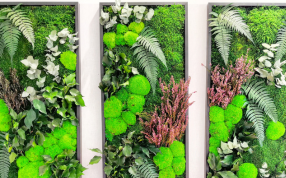
Artificial stems, branches, stakes, trailing plants and garlands: user guide
Published :
2025-12-09 15:58:05
Categories :
Trends
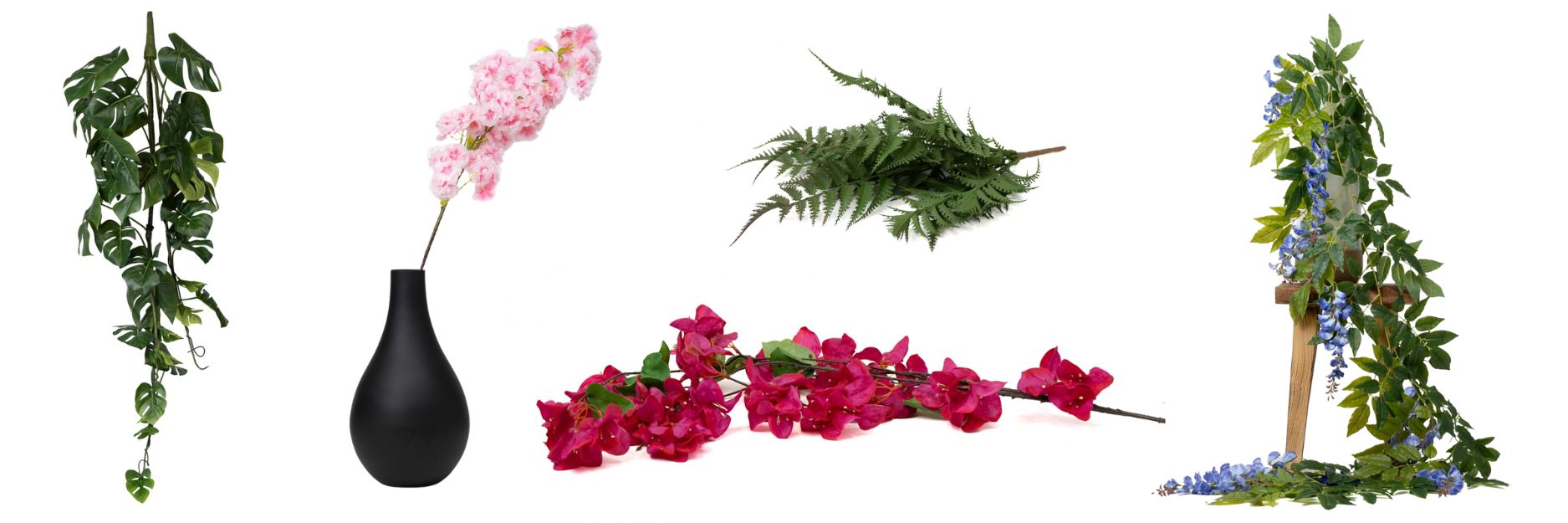
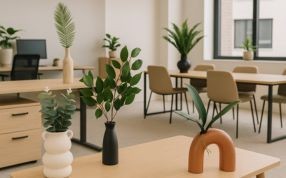
In professional plant design projects — shop windows, reception areas, commercial spaces, restaurants, hotels or event installations — the quality of the result depends as much on the plants themselves as on the technical elements that go with them: stems, branches, stakes, trailing plants and garlands. These often discreet components nevertheless influence the density, stability and realism of your creations. Understanding their role helps you save time, achieve a consistent result and, above all, obtain a natural finish that meets your clients’ high standards.
1. Artificial stems: flexibility, orientation and precision work
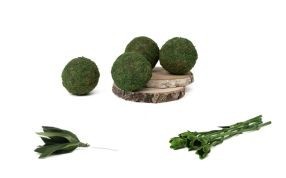
Stems are the base of artificial foliage and flowers. Their main advantage: flexibility, ideal for adjusting a composition down to the last millimetre.
Technical advantages
- Short to medium length
- Natural flexibility or reinforced with an internal metal wire
- Fine handling: you can orient, curve, adjust the height or open up the foliage
Real contribution to a composition
Stems allow you to refine every detail:
- adding movement to a bouquet or planter,
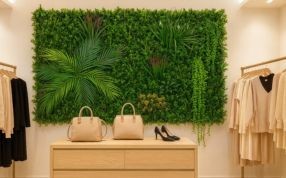
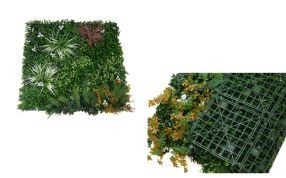
- creating relief in a green wall panel,
- adjusting the orientation of a leaf to harmonise the whole.
They help soften lines, break up overly vertical rigidity and add that slight irregularity that makes the planting look believable.
2. Artificial branches: height, structure and volume building
Longer and more robust than stems, branches bring structure and visual presence.
Technical advantages
- Greater length
- More pronounced rigidity
- Ability to create a full volume or architectural element
They are used as a framework to build decorative shrubs, XL bouquets or large statement pieces.
Why combine branches and stems?
A branch on its own provides height and overall direction. Stems, on the other hand, are used to work the edges, add finesse and coherence, and introduce natural variations between foliage levels. This combination avoids a compact block effect and creates an airy, structured, realistic construction — exactly what professionals look for when building long-lasting or semi-permanent décor.
3. Stakes: anchoring, support and adaptability
The stake is often the most underestimated technical element, even though it determines the stability of the whole composition.
Technical advantages
- Rigid rod that can be cut to match the depth of the pot or support
- Reliable fixation in polyurethane foam, clay pebbles, dense substrate or partition systems
- Long-lasting upright support, even in high-traffic areas
Practical applications
- countertop or reception desk pots,
- planters in hotels and restaurants,
- event scenography requiring quick assembly/disassembly,
- protected outdoor displays.
Stakes prevent plants from leaning or wobbling and secure the structure without the need for permanent gluing.
4. Artificial trailing plants: vertical dynamics and natural effect
Trailing plants end with a stake, which makes it easier to fix them into foam or any technical support.
Role within the composition
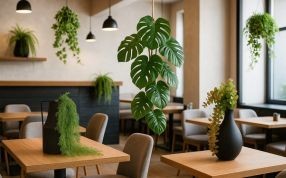
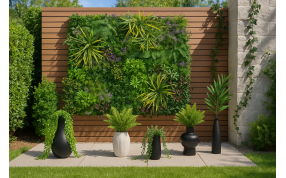
They are used to introduce a natural cascading effect in a green wall or a hanging arrangement. In panels, they break up the vertical lines — essential to avoid a “flat surface” look. In suspended décor, they add movement, softness and depth.
Advantages
- Natural, flowing drop
- Quick integration thanks to the stake
- Excellent effect when combined with a rigid structure (arches, ceilings, high shelves)
5. Artificial garlands: coverage, fluidity and dressing large areas
Garlands are designed to cover, wrap or dress a volume.
Main features
- Great length
- Enough flexibility to follow a frame or contour a structure
- Continuous look, ideal for creating a smooth, harmonious plant line
Use cases
- door or shop window frames,
- cladding of columns or posts,
- staging of reception areas,
- event décor requiring immediate visual impact.
Unlike trailing plants, which create vertical movement, garlands are used to work horizontal and contour lines.
6. How to choose the right element for your project constraints?
- To refine details, finishing and foliage direction → Stems
- To structure, create height or build volume → Branches
- To fix and stabilise in a pot, wall or scene → Stakes
- To introduce movement and break verticality → Trailing plants
- To quickly dress a surface or structure → Garlands
7. Building convincing décor: the methodology used by professionals
Here, we are no longer talking about each element separately, but about how they are assembled to create convincing, stable and coherent décor. Professionals think in terms of structure, depth and visual lines, not as a simple addition of parts.
Creating visual coherence
A harmonious décor is based on a subtle interplay between:
- branches for the framework,
- stems to balance and open,
- trailing plants to energise,
- garlands to link and dress.
This combination creates a smooth visual flow, with no harsh breaks.
Mastering depth
Depth is a key factor, especially in windows, lobbies or panels:
- the foreground is worked with stems,
- the middle ground with branches,
- the cascading parts with trailing plants,
- the outline with garlands.
This layering gives the illusion of living, dense and carefully constructed greenery.
Playing with controlled irregularities
Décor that is too symmetrical or too smooth looks artificial. Slight variations in angle, height or density create that “perfectly imperfect natural look” that professional clients appreciate.
In summary: for a strikingly realistic result
Mastering stems, branches, stakes, trailing plants and garlands means understanding the function of each element and how to combine them to create high-end, consistent and long-lasting décor. These are construction levers, not simple accessories, and when used correctly they allow you to effectively address both the technical and aesthetic requirements of professional spaces.
Go further: download the Phocealys Artificial range catalogue
Discover our full artificial range, must-have references and technical solutions tailored to demanding projects.
Partager cet article

-
 COMMITMENT PRICE QUALITY
-
 EXPERTS AT YOUR SERVICE
-
 RESERVED FOR PROFESSIONALS
-
.png) QUICK DELIVERY
QUICK DELIVERY
-
 SECURED PAYMENTS