












Fire Safety and Plant Decoration in ERP Buildings: Understanding Obligations
Published :
2026-06-11 12:46:40
Categories :
Products
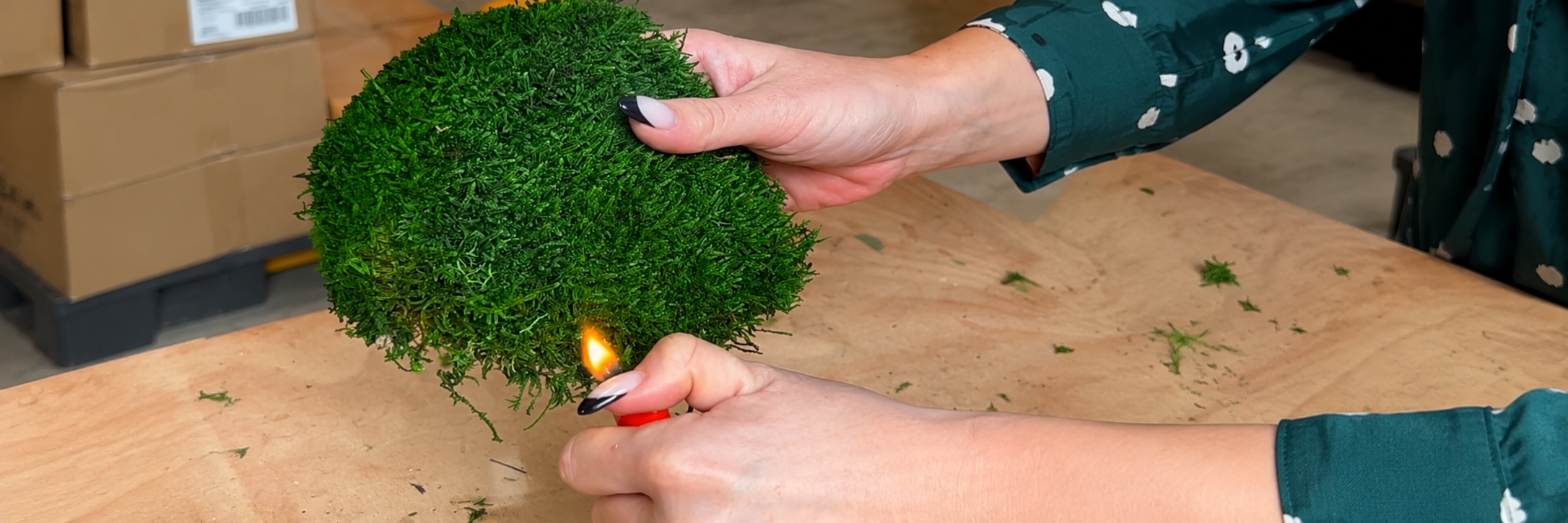
Plant-based decoration has become increasingly common in many spaces open to the public: hotels, restaurants, shops, coworking spaces, event venues and certain offices welcoming visitors.
Immersive green walls, suspended arrangements, dried flowers, artificial foliage and preserved plants now play a key role in the identity of spaces and the customer experience.
However, in some cases, these installations also fall within the scope of regulations applicable to ERP buildings (Establishments Receiving the Public) and fire safety requirements related to interior decorative materials.
Fire classifications, European standards, ERP obligations, preserved plants, dried flowers and suspended installations can quickly make the applicable rules complex to interpret.
The purpose of this article is to clarify the main regulatory obligations, the most common areas of interpretation and the best practices for securing a plant-based project while preserving its aesthetic and creative dimension.
What is an ERP?
An ERP (Établissement Recevant du Public) refers to a building, premises or enclosure in which external visitors are admitted, either freely or in return for payment. This includes hotels, restaurants, shops, shopping centres, event venues and certain coworking spaces.
However, not all professional spaces automatically fall under this regulation. Private offices or premises reserved exclusively for employees may, depending on their configuration and use, fall more under labour regulations than ERP regulations.
Nevertheless, even when a site is not subject to specific ERP obligations, fire risk prevention remains essential. The accumulation of combustible materials, suspended decorative installations, proximity to heat sources or high plant density can all represent points of vigilance in any interior design project.
Taking fire reaction into account from the design stage therefore makes it possible not only to meet regulatory requirements where they apply, but also to ensure the long-term safety of spaces and their occupants.
There is still frequent confusion on this subject: not all decorative plants are subject to the same requirements, and not all cases are explicitly defined by the regulations.
The issue is therefore not simply to “apply a fire-retardant treatment”, but to understand:
- which regulations apply;
- which obligations are clearly established;
- which situations depend on local interpretation;
- and how to secure a project from the design stage.
The reference text: the decree of 25 June 1980
In France, the main regulatory framework is the decree of 25 June 1980 approving the fire and panic safety regulations for ERP buildings.
Chapter AM — Interior fittings sets out the rules applicable to:
- decorative elements;
- coverings;
- fittings;
- materials present in areas accessible to the public.
Article AM 1 sets out the general principle: materials used in premises accessible to the public must have a fire reaction compatible with occupant safety.
This text may therefore concern:
- artificial plants;
- green walls;
- decorative panels;
- suspended elements;
- plant-based structures;
- and, depending on the case, preserved or dried plants.
Fire reaction and fire resistance: two different concepts
This is a very common source of confusion in interior design projects.
Fire reaction
Fire reaction measures how a material:
- ignites;
- spreads fire;
- emits smoke;
- produces flaming droplets.
This concept directly concerns:
- artificial plants;
- preserved mosses and lichens;
- dried flowers;
- plant panels;
- suspended decorative elements.
Fire resistance
Fire resistance refers to the ability of a construction element to:
- maintain its stability;
- limit the spread of flames;
- maintain its structural role for a given period.
Examples:
- an EI60 partition;
- a fire door;
- a fire-resistant structure rated for 1 hour.
A material classified M1 does not therefore mean that it is “fireproof”.
Fire classification: understanding the standards used in France and Europe
The French M0 to M4 classification
The historical French classification is based on standard NF P 92-507.
| Classification | Meaning |
| M0 | Non-combustible |
| M1 | Non-flammable |
| M2 | Hardly flammable |
| M3 | Moderately flammable |
| M4 | Easily flammable |
In ERP buildings, requirements vary depending on:
- the installed surface area;
- the installation method;
- the volume;
- the location;
- and the type of plant decoration.
Euroclasses: the European reference system
The European system NF EN 13501-1 is now used in most European countries.
It is based on:
- fire contribution (A to F);
- smoke production (s1 to s3);
- flaming droplets (d0 to d2).
Example:
B-s1,d0
- low contribution to fire;
- very low smoke emission;
- no flaming droplets.
France and Europe: still different approaches
France still widely uses the M0 to M4 classifications in ERP projects, even though Euroclasses are now integrated into regulations.
In other European countries:
- Belgium;
- Spain;
- Italy;
- Germany;
Euroclasses are now the dominant reference system.
For international projects, it is therefore essential to check:
- the applicable reference system;
- the available certifications;
- and the local requirements of the country concerned.
M1 and Euroclasses: beware of simplified equivalences
There is no automatic regulatory correspondence between the French classification and Euroclasses.
Generally accepted equivalences remain indicative:
| French classification | Indicative Euroclass equivalence |
| M0 | A1 / A2-s1,d0 |
| M1 | B-s1,d0 to B-s2,d0 |
| M2 | C-s1,d0 |
| M3 | D-s2,d0 |
| M4 | E |
Only official test reports and certificates can validate the compliance of a product.
What the regulations clearly target: artificial plants
Artificial plants are the case most explicitly covered by ERP regulations.
Article AM 19 specifies that:
- floral decorations made of synthetic materials must be limited in number;
- and, when used extensively, they must be classified at least M2.
The text also states that:
- artificial trees and plants over 1.70 m high must be classified M2;
- and placed out of reach of the public.
In practice:
- a small artificial decoration may benefit from a degree of tolerance;
- but an artificial green wall, a significant accumulation or an immersive installation requires a much more rigorous approach.
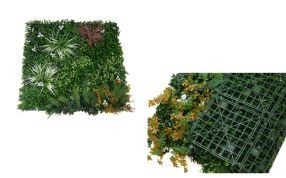
This is why some references are now offered directly with a fire-retardant treatment integrated during manufacturing, particularly artificial foliage panels intended for professional and ERP projects.
Technical solution: fire-retardant treatment for artificial plants
In certain bespoke projects or existing installations, it may be necessary to treat decorative elements after manufacturing.
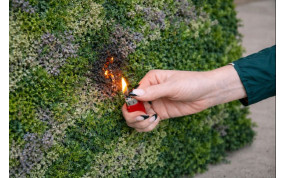
Fire-retardant sprays designed for artificial plants can then:
- improve fire reaction;
- adapt the treatment to the actual project;
- and preserve great creative freedom.
These solutions are particularly used in:
- scenography;
- event decorations;
- custom green walls;
- or temporary installations.
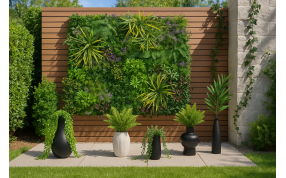
Green walls and decorative panels: the case of wall surfaces
Green walls and plant frames may fall under Article AM 9 relating to relief decorative elements fixed to vertical walls.
When their surface area exceeds 20% of the vertical walls of the room, the materials must be classified:
- minimum M2;
- or C-s3,d0 according to Euroclasses.
This directly concerns:
- large green walls;
- plant-covered panels;
- immersive decorative installations.
Important: fire classification must apply to the installed system
This point is often misunderstood in ERP projects.
An M1 or M2 certificate for a material alone does not automatically guarantee the compliance of the final installation.
The inspection body or safety commission may also take into account:
- the support;
- the adhesives;
- the structure;
- the total installed surface area;
- the installation method;
- the location in the room;
- or the overall combustible load of the project.
An M1-classified preserved moss or lichen fixed to a combustible wooden panel with an unsuitable adhesive may lead to a different assessment of the final system.
This is why test reports must always be analysed according to the actual conditions of use.
Plant suspensions and decorative ceilings: the highest level of requirement
Suspended installations are generally the most sensitive case.
Article AM 10 requires floating or suspended elements:
- garlands;
- decorative panels;
- aerial installations;
- plant suspensions;
to be classified M1 when they exceed 0.50 m² in:
- escape routes;
- rooms larger than 50 m²;
- circulation areas accessible to the public.
Plant ceilings and suspended decorations therefore require particular vigilance, especially in:
- hotels;
- restaurants;
- shopping centres;
- reception halls;
- or event spaces.
The specific case of preserved plants
Preserved plants occupy a more complex area within the regulations.
They are:
- neither fully considered synthetic materials;
- nor considered living plants.
The regulations do not explicitly mention them.
Depending on the case, they may therefore be interpreted as:
- a transformed natural material;
- a combustible decorative element;
- a decorative finish.
In practice, interpretation often depends on:
- the inspection body;
- the fire prevention officer;
- or the local safety commission.
In this context, using products with a fire classification is a real way to secure the project.
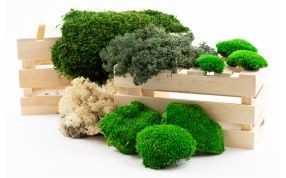
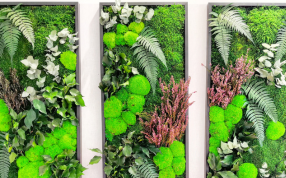
Some M1 fire-retardant preserved mosses and lichens now make it possible to meet ERP constraints while preserving the natural aesthetic sought in high-end plant-based interior design.
Technical solution: fire-retardant preserved mosses and lichens
M1-classified preserved mosses and lichens offer several advantages for professional projects:
- compliance suited to ERP constraints;
- natural plant appearance;
- no maintenance;
- integration into green walls, ceilings or scenography.
Preserved mosses and lichens are particularly used in green walls, plant-based signage, retail spaces and premium interior design projects for their natural appearance and lack of maintenance.
For bespoke installations, specific fire-retardant sprays for preserved mosses and lichens can also adapt the treatment to the project’s constraints.
Dried flowers: an aesthetic but sensitive material in ERP projects
Dried flowers and natural materials are particularly appreciated in:
- hotels;
- retail;
- restaurants;
- event scenography.
But they also present a critical point: their naturally high combustibility.
Unlike artificial plants, they are not explicitly defined in ERP regulations.
In practice, a small occasional decoration may be tolerated, but:
- significant accumulations;
- suspensions;
- decorative ceilings;
- or installations close to a heat source
may be considered problematic.
Technical solution: fire-retardant treatment for dried flowers
In this context, fire-retardant treatments designed for dried flowers and natural materials make it possible to:
- improve fire reaction;
- preserve the aesthetic appearance of the plants;
- and complete the technical file submitted to the inspection body.
These solutions are particularly relevant for:
- floral arrangements;
- scenography;
- suspended decorations;
- event installations;
- or retail design projects.
Even with treatment, validation by the inspection body remains recommended for sensitive ERP projects or large-scale installations.
The concept of combustible load: an often underestimated point
Beyond the fire classification of materials, safety commissions also analyse the overall combustible load of a space.
A significant accumulation of combustible decorative materials may be considered an aggravating factor:
- large plant ceilings;
- immersive walls;
- suspended decorations;
- event scenography;
- experiential retail spaces.
Even with classified materials, the installed volume, plant density and room configuration can influence the risk analysis.
Who actually validates a plant-based project in an ERP?
Several stakeholders are involved in analysing and validating projects:
| Stakeholder | Role |
| Inspection body | Checks technical compliance |
| Safety commission | Approves opening and operation |
| SDIS fire prevention officer | Analyses fire risk |
| Architect | Integrates regulatory constraints |
| Installer | Guarantees installation conditions |
This is why anticipation and technical documentation are essential from the design phase.
Key points for securing a plant-based project in an ERP
The compliance of a plant-based installation never depends solely on the plant material itself.
It also depends on:
- the support;
- the adhesives;
- the structure;
- the covered surfaces;
- the positioning;
- the escape routes;
- the heat sources;
- and the actual installation conditions.
Best practices therefore consist of:
- integrating fire safety from the design stage;
- choosing materials with a fire classification;
- keeping technical documentation;
- having sensitive projects validated by the relevant parties;
- and anticipating the constraints specific to each ERP.
Conclusion: towards a more technical approach to plant-based decoration
Plant-based decoration in ERP buildings is evolving towards increasingly ambitious, immersive and technical projects.
Today, the challenge is no longer only aesthetic.
It is also:
- regulatory;
- insurance-related;
- operational;
- and safety-related.
Products treated during manufacturing, M1-classified preserved mosses and lichens, fire-retardant sprays for artificial plants or dried flowers… technical solutions now exist to combine fire safety, creative freedom and aesthetic quality.
In this field, anticipation remains the best guarantee for designing compliant, durable and worry-free projects.
Partager cet article

-
 COMMITMENT PRICE QUALITY
-
 EXPERTS AT YOUR SERVICE
-
 RESERVED FOR PROFESSIONALS
-
.png) QUICK DELIVERY
QUICK DELIVERY
-
 SECURED PAYMENTS